
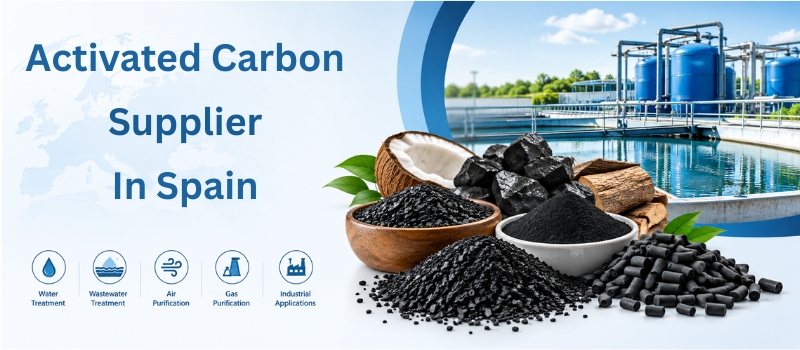
Looking for an activated carbon supplier in Spain for water treatment, wastewater treatment, air purification, food processing, pharmaceutical or other industrial applications?
MICBAC India manufactures activated carbon from coconut shell, coal and wood-based raw materials in granular, powdered and pelletised forms. Different grades are available for a wide range of liquid-phase and gas-phase purification applications.
For buyers in Spain, choosing the right activated carbon involves more than comparing price per tonne. The carbon grade should match the target contaminant, treatment process, particle size, adsorption requirements and operating conditions.
MICBAC India has an annual production capacity of 20,000 MT and manufactures a range of activated carbon grades for international industrial requirements. Product samples, Certificates of Analysis (CoA), Safety Data Sheets (SDS) and technical specifications are available for product evaluation and procurement.
Request a Sample | Get a Bulk Quote
Activated Carbon for Industrial Applications in Spain
Activated carbon is widely used as an adsorbent for removing unwanted substances from liquids and gases. However, different contaminants require different adsorption characteristics, so product selection should be based on the actual application.
MICBAC activated carbon can be used for applications including:
- Water treatment
- Wastewater treatment
- Industrial effluent treatment
- Air and gas purification
- Food and beverage processing
- Pharmaceutical applications
- Chemical processing
- Gold recovery
- Colour removal
- Taste and odour control
- Industrial purification
Whether the requirement is for a fixed-bed filtration system, powdered carbon dosing or gas-phase purification, the appropriate product grade should be selected according to the process requirements.
Activated Carbon Products Available from MICBAC India
MICBAC manufactures three main forms of activated carbon: Granular Activated Carbon, Powdered Activated Carbon and Activated Carbon Pellets.
Granular Activated Carbon
Granular Activated Carbon (GAC) is commonly used in fixed-bed and column filtration systems.
MICBAC manufactures coconut shell and coal-based granular activated carbon in different particle sizes and specifications.
Typical applications include:
- Water purification
- Drinking and process water treatment
- Wastewater treatment
- Dechlorination
- Taste and odour removal
- Industrial organic contaminant removal
- Gold recovery
- Air and gas purification
MICBAC’s current GAC range includes different particle sizes and grades. Coconut shell GAC specifications include iodine values of 900–1,200 mg/g, hardness of at least 98%, moisture up to 5% and ash up to 3%, while coal-based grades are available with iodine values from 500–1,100 mg/g and customised specifications.
Granular Activated Carbon
Powdered Activated Carbon
Powdered Activated Carbon (PAC) is used when activated carbon is dosed directly into a liquid treatment process.
It can be used for:
- Wastewater treatment
- Colour removal
- Decolourisation
- Organic contaminant adsorption
- Food processing
- Pharmaceutical applications
- Chemical processing
MICBAC manufactures coconut shell, coal-based and wood-based powdered activated carbon. Depending on the grade, available specifications include different iodine values, surface areas, moisture levels, ash content, pH and particle sizes. PAC grades can be supplied in mesh sizes such as 100–325 mesh depending on the product and requirement.
Powdered Activated Carbon
Activated Carbon Pellets
Activated carbon pellets are cylindrical forms of activated carbon used primarily in applications where controlled particle size, mechanical strength and gas-flow characteristics are important.
MICBAC manufactures coal-based, coconut shell and wood-based activated carbon pellets in different sizes and specifications.
Pelletised grades are available for applications including:
- Air purification
- Gas purification
- VOC removal
- Industrial gas treatment
- Hydrogen sulphide treatment
- Specialty gas purification
Depending on the grade, pellet diameters and specifications vary according to the intended application.
Activated Carbon Pellets
Coconut Shell vs Coal-Based Activated Carbon
The choice between coconut shell and coal-based activated carbon depends on the contaminant, molecular size and process conditions.
Coconut Shell Activated Carbon
Coconut shell activated carbon generally has a highly developed microporous structure. This makes suitable grades useful for applications involving smaller molecules, including certain water-treatment, dechlorination, taste and odour and gold-recovery applications.
MICBAC’s coconut shell grades are available in granular, powdered and pelletised forms with different specifications according to the application.
Coal-Based Activated Carbon
Coal-based activated carbon can provide a broader combination of micropores, mesopores and macropores. Certain grades are therefore suitable for larger molecules and complex industrial contaminants.
MICBAC offers coal-based activated carbon in granular, powdered and pelletised forms for different industrial applications.
The raw material alone does not determine performance. Activation method, pore structure, particle size, hardness, density and other specifications also need to be considered.
How to Choose the Right Activated Carbon Grade
One of the most common mistakes when buying activated carbon is choosing a product based only on its iodine number.
Iodine number is an important specification, but it does not automatically determine whether a carbon will be suitable for a particular contaminant or treatment system.
Before selecting a grade, consider:
Iodine Number
An indicator commonly used to characterise adsorption capacity and micropore development.
Methylene Blue Value
Useful for assessing adsorption behaviour involving larger molecules and certain colour-removal applications.
Surface Area
Provides information about the developed internal surface of the carbon, although higher surface area alone does not guarantee better performance for every application.
Pore Size Distribution
The balance of micropores, mesopores and macropores affects the accessibility of contaminants of different molecular sizes.
Particle Size
Particle size can influence adsorption kinetics, pressure drop, filtration behaviour and handling.
Hardness
Important where carbon is subject to handling, backwashing, abrasion or repeated use.
Moisture and Ash
These parameters can affect product quality, loading calculations and suitability for specific processes.
Bulk Density
Important for vessel loading, storage and volumetric calculations.
pH
Relevant when considering compatibility between the carbon and the treatment process.
Most importantly, product selection should consider the target contaminant, concentration, flow rate, contact time, carbon dosage and operating conditions.
Why Choose MICBAC India for Activated Carbon Supply?
When purchasing activated carbon internationally, buyers should evaluate manufacturing capability, product consistency, technical specifications and documentation alongside price.
MICBAC India was established in 1992 and currently states an annual production capacity of 20,000 MT, two manufacturing plants and 32 product grades. The company manufactures coconut shell, coal-based and wood-based activated carbon in different product forms.
Multiple Activated Carbon Grades
MICBAC provides granular, powdered and pelletised activated carbon made from different raw materials, allowing product selection according to application requirements.
Technical Specifications
Product specifications include parameters such as iodine number, hardness, moisture, ash, apparent or bulk density, mesh size and pore structure, depending on the product.
Quality Documentation
MICBAC states that its production and quality processes are supported by ISO 9001:2015, with additional certifications such as Kosher, Halal and HACCP listed for relevant product ranges. Product pages also provide technical specifications and documentation information.
Product Samples
Samples are available for product evaluation, allowing buyers to assess a suitable grade before moving to larger procurement quantities. MICBAC states that samples can be supplied with CoA and SDS documentation.
International Supply Capability
MICBAC manufactures activated carbon in India and maintains export and dispatch infrastructure for international orders. The company identifies export ports including Paradip, Kolkata and Mumbai.
For buyers in Spain, specific product availability, packaging, documentation and shipment arrangements should be confirmed according to the order and destination.
Activated Carbon Supply to Spain
Spanish buyers sourcing activated carbon from an international manufacturer should consider both technical suitability and procurement requirements.
Before requesting a quotation, it is useful to provide:
- Application
- Target contaminant
- Liquid or gas phase
- Flow rate
- Contact time
- Existing treatment system
- Required carbon type
- Particle size
- Adsorption requirements
- Moisture and ash limits
- Hardness requirements
- Packaging requirements
- Expected order quantity
- Delivery destination
- Required delivery schedule
- Required technical documentation
Providing these details helps the supplier evaluate the appropriate grade rather than simply recommending a standard product.
For recurring requirements, buyers should also discuss production availability, packaging, shipment planning and lead times before placing an order.
Test Activated Carbon Before Bulk Procurement
A product sample can help determine whether a particular activated carbon grade is suitable for an application.
Testing should ideally be performed under conditions that represent the intended process. Depending on the application, evaluation may consider contaminant removal, adsorption capacity, dosage, contact time and other operating parameters.
MICBAC provides product samples for evaluation and states that standard samples can be supplied with CoA and SDS documentation.
Laboratory testing should not automatically be considered a guarantee of full-scale performance. Actual results can vary depending on contaminant concentration, competing substances, water or gas chemistry, flow rate, contact time, carbon dosage and system design.
Consider Total Cost, Not Only Price Per Tonne
When comparing an activated carbon supplier in Spain with an international supplier, the purchase price per tonne should not be the only consideration.
Also evaluate:
- Carbon consumption
- Replacement frequency
- Required dosage
- Transport and freight
- Packaging
- Disposal or regeneration requirements
- Labour
- Equipment downtime
- Treatment performance
- Supply continuity
A technically suitable activated carbon grade can be more important to overall operating economics than simply selecting the lowest initial purchase price.
Common Mistakes When Buying Activated Carbon
Choosing Only by Iodine Number
A higher iodine number does not automatically mean that a carbon is suitable for every contaminant.
Choosing Only by Raw Material
Coconut shell, coal and wood-based activated carbons have different pore structures and characteristics. The final product specification also matters.
Ignoring Particle Size
Particle size can affect adsorption kinetics, pressure drop, filtration and handling.
Buying Without Testing
Where the application is important, evaluate a representative sample before committing to a larger order.
Comparing Only Price
Consider consumption, replacement frequency, transport, disposal and operating requirements.
Ignoring Documentation
Technical specifications, CoA, SDS and applicable certification documents can be important for product approval and procurement.
Frequently Asked Questions
What is the best activated carbon for water treatment in Spain?
There is no single activated carbon grade suitable for every water-treatment application. The appropriate product depends on the target contaminant, water characteristics, flow rate, contact time, particle size and required adsorption properties.
How do I choose an activated carbon supplier in Spain?
Evaluate manufacturing capability, product range, technical specifications, quality procedures, product samples, documentation, production capacity, export capability, packaging and the supplier’s ability to support recurring requirements.
What specifications should I request from an activated carbon supplier?
Depending on the application, request iodine number, methylene blue value, surface area, pore structure, particle size, hardness, moisture, ash, bulk or apparent density, pH and relevant test information.
Is coconut shell activated carbon better than coal-based activated carbon?
Neither is universally better. Coconut shell and coal-based activated carbons have different pore structures and can be suitable for different contaminants and applications.
Can MICBAC India supply activated carbon to Spain?
MICBAC India manufactures activated carbon for international markets and has export infrastructure in India. Spanish buyers can contact MICBAC to confirm the appropriate product grade, availability, documentation, packaging and shipment requirements for their order.
What documents should I request when buying activated carbon?
Depending on the application, you may require a Technical Data Sheet, Certificate of Analysis, Safety Data Sheet, applicable certification or compliance documentation and product specifications.
How can I test whether an activated carbon grade is suitable?
Request a representative sample and evaluate it under relevant laboratory or pilot conditions. For critical applications, testing should reflect actual operating conditions as closely as possible.
What is the difference between GAC and PAC?
GAC consists of larger carbon particles and is commonly used in fixed-bed and column filtration systems. PAC is a powdered form that can be dosed directly into liquid treatment processes. The appropriate form depends on the treatment system and process requirements.
Request Activated Carbon for Spain
Looking for an activated carbon supplier in Spain for your next project or recurring requirement?
MICBAC India manufactures granular activated carbon, powdered activated carbon and activated carbon pellets from coconut shell, coal and wood-based raw materials.
Share your:
Application | Target Contaminant | Required Product | Quantity | Delivery Destination
Our team can evaluate your requirements and provide the relevant product specifications and commercial information.