
Choosing an Activated Carbon Supplier in New York involves more than comparing prices or selecting a product with the highest iodine value. For water treatment, wastewater treatment, air purification, gas filtration, and industrial processes, the carbon grade needs to match the contaminant, operating conditions, equipment, and treatment objective.
Activated carbon works through adsorption, but its effectiveness depends on factors such as pore structure, raw material, particle size, contact time, flow conditions, and contaminant characteristics. A cheaper carbon is not necessarily the economical option. If it exhausts quickly or performs poorly in the system, replacement and operating costs can outweigh the initial savings.
For buyers sourcing activated carbon for facilities in New York, this guide explains the major carbon types, technical specifications, applications, supplier-selection criteria, testing considerations, and sourcing factors that should be evaluated before purchasing.
What Is Activated Carbon and How Does It Work?
Activated carbon is a porous carbonaceous adsorbent used to capture selected contaminants from liquids and gases. During activation, the carbon develops a network of pores that provides a large internal surface for adsorption.
The process is called adsorption, rather than absorption. Suitable molecules attach to surfaces within the carbon’s pore structure instead of simply being taken into the bulk material.
Commercial activated carbon can be produced from raw materials such as:
- Coconut shell
- Coal
- Wood
The raw material and activation process influence pore distribution and other physical properties. This is important because contaminants vary in molecular size, concentration, polarity, and behavior.
As a result, a carbon grade suitable for one application may not provide the same performance in another. The right selection should be based on the actual treatment requirement rather than the product name alone.
Why Activated Carbon Selection Matters for New York Buyers
Industrial and commercial facilities can have very different treatment requirements. A water-treatment system may target organic compounds, taste, odor, or selected contaminants, while an air-treatment system may be designed for VOCs, odors, or other gaseous compounds.
Before requesting quotations, buyers should understand:
- Target contaminant and concentration
- Water or gas flow rate
- Temperature and pH, where relevant
- Required contact time
- Carbon bed depth and equipment configuration
- Particle-size requirements
- Required treatment performance
- Expected carbon replacement frequency
- Disposal or regeneration requirements
- Packaging and storage conditions
For a buyer in New York, these details become particularly important when comparing domestic inventory with material sourced internationally. Lead time, shipping arrangements, documentation, and repeat-order planning can affect the practical cost and reliability of the supply.
Types of Activated Carbon for Industrial Applications
Granular Activated Carbon (GAC)
Granular activated carbon consists of larger particles and is commonly used in fixed-bed filtration systems. Water or gas passes through a carbon bed, allowing contaminants to interact with the adsorbent.
Typical applications include:
- Water purification
- Wastewater treatment
- Industrial process water
- Air and gas filtration
- Food and beverage processing
- Selected chemical and industrial processes
Particle size influences both adsorption kinetics and hydraulic behavior. A smaller particle can provide faster mass transfer, but excessive fines may increase pressure drop or create handling problems.
MICBAC lists coal-based and coconut-shell granular activated carbon for applications including water purification, wastewater treatment, industrial water treatment, food processing, and other industrial uses.
Powdered Activated Carbon (PAC)
Powdered activated carbon has much smaller particles than GAC and can be dispersed directly into suitable liquid treatment processes. Its smaller particle size can support relatively rapid interaction with contaminants.
PAC may be considered for:
- Water treatment
- Wastewater and effluent treatment
- Industrial spills
- Color and odor control
- Oil refining
- Selected industrial purification processes
After treatment, PAC generally needs to be separated from the treated stream according to the process design.
MICBAC’s published product information includes coal-, wood-, and coconut-shell powdered activated carbon and identifies applications including water treatment, wastewater treatment, air purification, oil refining, and industrial processes.
Activated Carbon Pellets
Pelletized activated carbon is formed into cylindrical particles and can be useful in applications where airflow, particle strength, and predictable bed behavior are important.
Potential applications include:
- Air purification
- Gas filtration
- VOC treatment
- Odor control
- Solvent recovery
- Industrial gas treatment
MICBAC lists coal-, coconut-shell-, and wood-based activated carbon pellets. Its product information describes applications involving gas purification, solvent recovery, wastewater treatment, and other filtration uses.
Quick Comparison of Carbon Types
| Carbon Type | Typical Applications | Key Consideration |
|---|---|---|
| GAC | Water, wastewater, air and process filtration | Particle size, bed design and contact time |
| PAC | Water and wastewater treatment | Dosing, dispersion and carbon separation |
| Pellets | Air and gas filtration, VOC and odor control | Diameter, strength and airflow |
Coconut-Shell, Coal-Based, or Wood-Based Carbon?
The raw material is an important selection factor because it influences pore structure and the physical characteristics of the finished carbon.
Coconut-Shell Activated Carbon
Coconut-shell carbon is commonly associated with a microporous structure and is used in various water, air, and purification applications. It can be suitable where the target contaminants interact effectively with its pore structure.
Coal-Based Activated Carbon
Coal-based carbon is used across a broad range of water, wastewater, air, and industrial applications. Depending on the grade and manufacturing process, its pore structure can contain different proportions of micropores and larger pores.
Wood-Based Activated Carbon
Wood-based carbon can provide pore characteristics suited to selected liquid-phase applications, including some decolorization and purification processes involving larger organic molecules.
Raw material alone does not determine which carbon will perform best. The grade, pore structure, contaminant, particle size, and operating conditions matter just as much. The specific grade, pore distribution, contaminant, particle size, and operating conditions should all be considered.
Technical Specifications Buyers Should Compare
A technical datasheet provides a better basis for comparison than a product name or a single headline specification.
Iodine Value
Iodine value is commonly used as an indicator related to adsorption capacity associated with smaller pores. It can be useful when comparing certain grades, but it is not a universal measure of performance.
A higher iodine value does not automatically mean a carbon is better for every contaminant.
Particle Size and Mesh
Particle size affects adsorption kinetics, pressure drop, contact characteristics, dust generation, and separation requirements.
For GAC, the selected mesh range should suit the filtration equipment and operating conditions. For PAC, particle size influences dispersion and how the carbon is subsequently separated.
Moisture
Moisture content matters when carbon is purchased by weight and can also affect storage and handling. Buyers should compare moisture specifications consistently between suppliers.
Ash Content
Ash represents inorganic material remaining in the carbon. Depending on the process, ash content can affect purity, water chemistry, and overall suitability.
Hardness and Mechanical Strength
Mechanical strength is important in fixed-bed applications because carbon particles can experience abrasion during transportation, loading, backwashing, and operation. Excessive breakdown can generate fines and contribute to operating problems.
Methylene Blue and Other Indicators
Methylene blue adsorption can provide additional information about adsorption behavior toward larger molecules and may be useful for evaluating selected liquid-phase carbons.
A better comparison looks at the specification sheet as a whole. Iodine value can be useful, but it should be considered alongside particle size, ash, moisture, hardness, and the requirements of the application.
What Makes a Reliable Activated Carbon Supplier?
A reliable supplier should provide more than a competitive quotation. Buyers should evaluate whether the supplier can consistently meet the technical and commercial requirements agreed for the application.
Important factors include:
- Application-specific carbon grades
- Consistent product specifications
- Technical datasheets
- Certificate of Analysis where applicable
- Safety Data Sheet where applicable
- Batch consistency and traceability where applicable
- Representative samples
- Appropriate packaging
- Clear shipping arrangements
- Realistic lead-time planning
- Repeat-order consistency
- Responsive technical communication
For a New York buyer sourcing internationally, documentation and logistics deserve particular attention. Before placing an order, clarify shipping responsibilities, packaging, expected transit time, required documentation, and the process for handling repeat orders.
The supplier should also understand why the carbon is being purchased. A recommendation based only on iodine value or price is less useful than one based on the contaminant, equipment, operating conditions, and treatment objective.
Local vs International Activated Carbon Suppliers
New York buyers may source activated carbon from local distributors, domestic suppliers, or international manufacturers. None of these options is automatically better.
A local supplier may offer easier domestic logistics, access to local inventory, or potentially shorter delivery times. An international manufacturer may provide direct access to manufacturing and a broader range of carbon grades, but the buyer may need to plan for international shipping, longer lead times, import responsibilities, and specific packaging requirements.
When comparing suppliers, consider:
- Product availability
- Technical suitability
- Lead time
- Shipping responsibility
- Documentation
- Minimum order requirements
- Batch consistency
- Packaging
- Technical communication
- Total delivered cost
- Ability to maintain repeat supply
The right sourcing model depends on the application, purchasing volume, urgency, and long-term supply requirements.
Manufacturer vs Distributor: What Should Buyers Compare?
A manufacturer and a distributor can both be appropriate sources, depending on the purchasing requirement.
Manufacturer
Potential advantages to evaluate include:
- Direct manufacturing relationship
- Access to multiple carbon grades
- Application-specific product options
- Direct technical communication
- Greater visibility into production specifications
- Potential for product or packaging customization where offered
Distributor
Potential advantages may include:
- Local inventory
- Domestic delivery arrangements
- Easier replenishment for urgent requirements
- Potentially smaller or more flexible order quantities
Neither model guarantees better quality or service. Buyers should compare the actual product, specifications, documentation, availability, batch consistency, lead time, logistics, and total procurement requirements.
Why Samples and Application Testing Matter
Activated carbon performance depends on actual process conditions. Two products with similar iodine values can behave differently because of differences in pore distribution, particle size, surface characteristics, and contaminant interactions.
A practical evaluation process is:
- Identify the target contaminant.
- Define the treatment objective.
- Document flow rate and operating conditions.
- Shortlist technically suitable carbon grades.
- Compare specifications and documentation.
- Test representative material where practical.
- Confirm the agreed product specification.
- Finalize packaging and shipping requirements.
- Monitor performance after installation.
Sample testing is particularly useful when changing carbon grades, entering a new application, or purchasing substantial quantities. MICBAC’s product pages state that samples can be provided for performance testing, although buyers should confirm availability and applicable arrangements for their specific requirement.
Common Activated Carbon Applications
Water and Wastewater Treatment
Activated carbon can be used for adsorption of selected organic compounds and for applications involving taste, odor, color, and other contaminants, depending on the carbon grade and treatment design.
GAC is commonly considered for fixed-bed systems, while PAC can be introduced into suitable treatment processes.
Air Purification and VOC Removal
Activated carbon can adsorb selected VOCs, odors, and other gaseous contaminants. Pelletized carbon can be considered where airflow, particle strength, and bed configuration are important.
Food and Beverage Processing
Activated carbon is used in selected purification and decolorization processes. The appropriate grade should be evaluated against the specific process and applicable product requirements.
Pharmaceutical Applications
Activated carbon may be used in certain purification processes. Buyers should evaluate grade suitability, purity requirements, documentation, and the requirements of the particular manufacturing process.
Gold Recovery
Activated carbon is also used in gold-recovery processes because of its adsorption characteristics toward gold-bearing complexes under suitable process conditions.
Common Mistakes When Buying Activated Carbon
Choosing Only by Price
The lowest purchase price does not necessarily produce the lowest overall treatment cost. Replacement frequency, handling, transport, and process performance can all influence total cost.
Assuming Higher Iodine Value Is Always Better
Iodine value is only one indicator. Pore structure and the characteristics of the target contaminant also matter.
Ignoring Particle Size
An unsuitable particle size can affect pressure drop, adsorption kinetics, dust generation, and equipment operation.
Treating Carbon Grades as Interchangeable
Coconut-shell, coal-based, and wood-based carbons can have different properties. Substituting one grade for another should therefore be technically evaluated.
Skipping Application Testing
For critical applications or substantial purchases, failing to test representative material can create avoidable process risk.
Ignoring Documentation and Supply Planning
A technically suitable carbon can still create procurement problems if documentation, batch consistency, shipping arrangements, or replenishment lead times are unclear.
Questions to Ask an Activated Carbon Supplier
Before placing an order, procurement and engineering teams should ask:
- Which carbon grade is appropriate for the target contaminant and process?
- What raw material is used?
- What particle size or mesh range is available?
- What are the relevant iodine value, moisture, ash, hardness, and other specifications?
- Can the supplier provide a current technical datasheet?
- Is a Certificate of Analysis or other documentation available where applicable?
- Can representative samples be tested?
- How is batch-to-batch consistency managed?
- What packaging and shipping options are available?
- What lead time should be planned for repeat orders?
These questions help buyers compare suppliers on technical suitability and procurement reliability rather than price alone.
MICBAC as an Activated Carbon Supplier for Industrial Buyers
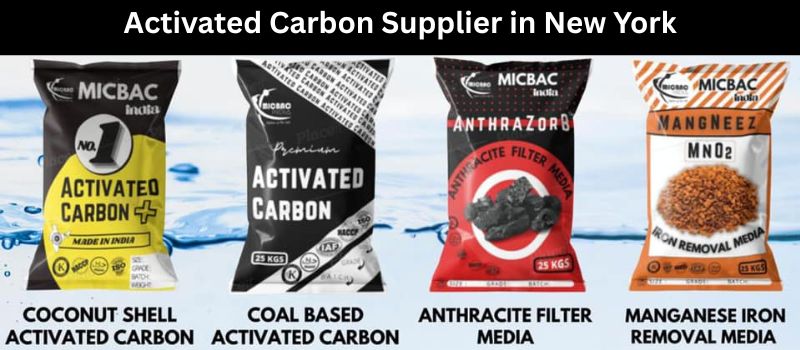
MICBAC India identifies itself as an activated carbon manufacturer and lists granular activated carbon, powdered activated carbon, and activated carbon pellets among its product categories. Its website states that it produces activated carbon from coconut shell, coal, and wood-based raw materials. It also identifies applications including air filtration, gold recovery, pharmaceuticals, water purification, food and beverage, and flue gas treatment.
The company publishes separate product information for its granular, powdered, and pelletized activated carbon ranges. For example, its published granular-carbon information covers coal and coconut-shell grades, while its powdered-carbon information includes coal, wood, and coconut-shell categories.
MICBAC also states that its services include quality-control and assurance programs, tailor-made solutions, and logistics and timeline management. These are company-stated capabilities and should be evaluated against the specific requirements of an individual procurement project.
For buyers in New York evaluating MICBAC or another international supplier, the appropriate comparison remains application-specific: product grade, technical specifications, sample suitability, documentation, packaging, lead time, shipping arrangements, and repeat-order consistency should all be assessed before procurement.
FAQs About Activated Carbon Suppliers in New York
1. How do I choose an activated carbon supplier in New York?
Start by defining the contaminant, treatment objective, flow conditions, carbon type, and required particle size. Then compare suppliers based on technical specifications, documentation, sample testing, batch consistency, packaging, lead times, and total delivered cost.
2. What type of activated carbon is best for water treatment?
There is no single best grade for every water-treatment application. GAC, PAC, coconut-shell carbon, and coal-based carbon can each be appropriate depending on the contaminants, process design, contact time, and operating conditions.
3. Is coconut-shell or coal-based activated carbon better?
Neither is universally better. The two materials can produce different pore structures and physical characteristics. The appropriate choice depends on the target contaminant and treatment objective rather than raw material alone.
4. What specifications should I compare between activated carbon suppliers?
Relevant specifications can include iodine value, particle size, moisture, ash, hardness, density, methylene blue value where applicable, and application-specific performance data. Documentation and batch consistency should also be evaluated.
5. Can an international activated carbon manufacturer supply buyers in New York?
Yes. International sourcing can be practical when the supplier can meet the required specifications and the buyer can plan for shipping, lead times, documentation, import responsibilities, packaging, and repeat supply. The decision should be based on total procurement requirements rather than location alone.
Conclusion
Choosing an Activated Carbon Supplier in New York should begin with the treatment requirement rather than the lowest quoted price. The appropriate carbon depends on the contaminant, water or gas conditions, pore structure, raw material, particle size, contact time, and filtration system.
Buyers should compare complete technical specifications, evaluate samples where appropriate, confirm documentation and batch consistency, and plan packaging and logistics carefully. Local distributors, domestic suppliers, and international manufacturers can all be viable depending on the application’s requirements and procurement priorities.
For water treatment, wastewater treatment, air filtration, gas purification, or another industrial process, the strongest purchasing decision is based on verified product suitability, consistent specifications, and dependable supply—not on a single headline specification.