
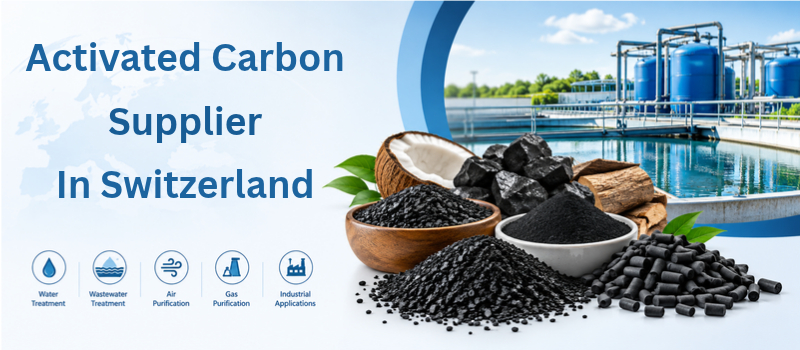
Finding the right activated carbon supplier in Switzerland is about more than finding a competitive price. The carbon needs to match the application, target contaminants, operating conditions and treatment objectives.
Activated carbon is widely used for water purification, wastewater treatment, air and gas purification, food and beverage processing, pharmaceutical applications, chemical processing and other industrial processes. Because every application has different requirements, choosing the correct grade is an important part of achieving consistent treatment performance.
MICBAC India manufactures activated carbon from coconut shell, coal and wood and supplies Granular Activated Carbon, Powdered Activated Carbon and Activated Carbon Pellets for industrial applications.
For businesses in Switzerland looking for an international supplier, the right approach is to evaluate product specifications, manufacturing capability, documentation, samples, logistics and long-term supply requirements before placing an order.
Activated Carbon Supplier in Switzerland for Industrial Applications
Activated carbon is a porous form of carbon that adsorbs certain organic compounds, impurities, colours, odours and other contaminants from liquid and gas streams.
However, activated carbon is not a universal product. Different grades have different pore structures, adsorption characteristics, particle sizes and physical properties.
The carbon that works well for a drinking-water application may not be the right choice for industrial wastewater, liquid decolourisation or gas purification.
MICBAC supplies activated carbon for applications including:
- Water treatment
- Industrial wastewater treatment
- Process water purification
- Air purification
- Gas purification
- Food and beverage processing
- Pharmaceutical applications
- Chemical processing
- Liquid decolourisation
- Gold recovery
- Industrial pollution control
The objective is to match the carbon to the process rather than selecting a product simply because it has a high iodine number or a low purchase price.
Granular Activated Carbon for Water and Industrial Treatment
Granular Activated Carbon, commonly known as GAC, is widely used in fixed-bed filters and adsorption columns.
It can be used for applications such as water purification, wastewater polishing, dechlorination, taste and odour control and the reduction of certain organic contaminants. GAC is also used in selected air and gas purification systems.
MICBAC manufactures granular activated carbon using coconut shell and coal-based raw materials.
Coconut shell and coal-based carbons can have different pore structures and adsorption characteristics. Coconut shell carbon is generally associated with a microporous structure, while coal-based carbon can provide a broader combination of micropores, mesopores and macropores.
The correct choice depends on the contaminant and process rather than the raw material alone.
Particle size is also important. It can influence adsorption rate, pressure drop, filtration behaviour and the way carbon performs inside a treatment system.
Powdered Activated Carbon for Water and Wastewater Treatment
Powdered Activated Carbon, or PAC, is a fine form of activated carbon that can be dosed directly into a process stream.
PAC can be useful when treatment conditions require rapid adsorption or when the process is better suited to dosing carbon rather than operating a permanent fixed carbon bed.
Typical applications include:
- Industrial wastewater treatment
- Effluent treatment
- Colour removal
- Liquid purification
- Process treatment
- Selected water-treatment applications
MICBAC manufactures powdered activated carbon from different raw materials, including coconut shell, coal and wood.
When selecting PAC, buyers should consider the target contaminant, dosage, contact time, particle size, adsorption characteristics, moisture, ash and pH.
For decolourisation and applications involving larger organic molecules, pore structure and methylene blue value can also be important considerations.
Activated Carbon Pellets for Air and Gas Purification
Activated carbon pellets are cylindrical particles commonly used in fixed-bed air and gas purification systems.
Pellet size, hardness, adsorption capacity and mechanical strength can influence how the carbon performs during operation.
MICBAC supplies activated carbon pellets using different raw materials, including coal and coconut shell.
For gas-phase applications, buyers should look beyond iodine number. Gas composition, contaminant concentration, gas flow rate, temperature, humidity, bed dimensions and required operating time can all influence carbon selection.
A technically suitable pellet should therefore be selected according to the actual gas-treatment conditions.
Coconut Shell or Coal-Based Activated Carbon?
One of the most common questions when buying activated carbon is whether coconut shell carbon is better than coal-based carbon.
There is no single answer.
Coconut shell activated carbon generally contains a high proportion of micropores. This can make it useful for many applications involving smaller molecules and certain water-treatment requirements.
Coal-based activated carbon can provide a broader pore structure containing micropores, mesopores and macropores. This can be useful for larger molecules and more complex industrial contaminants.
Raw material is therefore only one part of the selection process.
Activation method, pore distribution, particle size, hardness, surface area and the characteristics of the contaminant can all affect the final adsorption performance.
How to Choose the Right Activated Carbon Grade
Selecting activated carbon based on one specification is a common purchasing mistake.
Iodine number is an important parameter, but a high iodine number does not automatically mean that the carbon is suitable for every application.
Depending on the process, buyers should evaluate several technical parameters.
Iodine Number
Iodine number is commonly used as an indicator of adsorption capacity associated with microporosity and smaller molecules.
Methylene Blue Value
Methylene blue value can provide useful information about adsorption behaviour towards comparatively larger molecules.
Surface Area
Surface area indicates the internal surface available for adsorption. However, a higher surface area does not automatically mean better performance for every contaminant.
Pore Size Distribution
Micropores, mesopores and macropores influence which molecules can enter and interact with the internal carbon structure.
Particle Size
Particle size can affect adsorption kinetics, pressure drop, filtration performance and handling.
Hardness
Hardness is particularly important for granular and pelletised carbon used in systems where abrasion and carbon loss need to be controlled.
Moisture and Ash
Moisture and ash are important quality parameters that can affect handling, storage and the effective carbon content of the product.
Bulk or Apparent Density
Density is useful when calculating the quantity of carbon required by volume and planning transportation and storage.
pH
The pH of activated carbon can be relevant when the carbon is introduced into sensitive process streams.
These parameters should be considered together with contaminant type, concentration, flow rate and contact time.
Why Choose an Activated Carbon Manufacturer Carefully?
For industrial buyers, the supplier is just as important as the product specification.
A reliable procurement process should consider manufacturing capability, product consistency, technical support and the ability to supply the required grade repeatedly.
Before choosing an activated carbon supplier, consider:
Manufacturing Capability
A manufacturer with established production facilities can provide greater control over raw materials, activation and product specifications.
MICBAC India states an annual activated carbon production capacity of 20,000 metric tonnes and manufactures carbon using coconut shell, coal and wood.
Product Range
Having multiple product forms and raw-material options can make it easier to evaluate a grade that fits the application.
MICBAC’s range includes granular, powdered and pelletised activated carbon.
Batch Consistency
Consistent specifications are important when carbon is used continuously in an industrial process.
Buyers should review batch-related testing and confirm that the supplied product meets the approved specification.
Technical Documentation
Before purchasing, request appropriate technical documentation such as:
- Technical Data Sheet
- Certificate of Analysis
- Safety Data Sheet
- Product specification
- Packaging information
- Relevant quality documentation
This helps procurement and technical teams evaluate the material before approval.
Product Samples
A sample can provide an opportunity to evaluate the proposed grade before committing to a larger quantity.
Where possible, testing should be carried out using representative process water, wastewater, liquid or gas conditions.
Laboratory testing is useful, but results should not automatically be treated as a guarantee of full-scale performance.
Why Consider MICBAC India for Switzerland Requirements?
MICBAC India has manufactured activated carbon since 1992 and supplies activated carbon to international markets.
The company manufactures:
- Coconut shell activated carbon
- Coal-based activated carbon
- Wood-based activated carbon
- Granular Activated Carbon
- Powdered Activated Carbon
- Activated Carbon Pellets
Its current manufacturing information states an annual production capacity of 20,000 metric tonnes.
For international buyers, MICBAC provides product specifications and supports sample-based evaluation for its activated carbon grades.
The important point for a Swiss buyer is not simply where the carbon is manufactured. The proposed grade should be evaluated against the required specification, application, documentation and commercial requirements before a bulk order is approved.
Activated Carbon for Water Treatment in Switzerland
Water-treatment applications can have very different requirements depending on the source water and target contaminants.
Activated carbon may be used for organic contaminant reduction, taste and odour control, dechlorination and other treatment objectives.
Before selecting a carbon grade, consider:
- Target contaminant
- Inlet water quality
- Flow rate
- Contact time
- Carbon-bed depth
- Operating temperature
- pH
- Required particle size
- Adsorption requirement
- Carbon replacement frequency
- Disposal requirements
For a new application, representative testing can help determine whether the proposed carbon performs as required.
Activated Carbon for Industrial Wastewater
Industrial wastewater can contain different combinations of organic compounds, colour, chemicals and other contaminants.
Activated carbon can be used as part of a wider treatment system to reduce specific contaminants or provide polishing after other treatment stages.
The correct carbon grade should be selected according to the actual wastewater rather than using a general-purpose product for every application.
Important parameters can include iodine number, methylene blue value, pore-size distribution, surface area, particle size, ash, moisture and adsorption kinetics.
Testing the proposed carbon against representative wastewater can provide more useful information than relying only on standard product specifications.
Buying Activated Carbon from India for Switzerland
International procurement requires planning beyond the technical specification.
Swiss buyers should consider:
- Required quantity
- Packaging format
- Shipment method
- Export documentation
- Import requirements
- Delivery destination
- Expected lead time
- Freight costs
- Storage requirements
- Safety documentation
- Future replenishment requirements
For regular consumption, purchasing should also be planned around actual usage so that stock does not become critically low before the next shipment arrives.
Consistent supply is particularly important when activated carbon is part of a continuous treatment or production process.
Do Not Compare Suppliers Only on Price Per Tonne
The quoted price is only one part of the total cost of activated carbon.
A better comparison considers:
Purchase price + carbon consumption + replacement frequency + transportation + dosing + disposal + labour + downtime.
A lower-priced carbon may not necessarily provide the lowest overall operating cost if it is consumed faster or does not perform effectively under the actual process conditions.
For this reason, technical suitability should be considered alongside commercial pricing.
Test the Carbon Before a Large Purchase
A specification sheet can tell you important things about a carbon, but it cannot completely predict how that product will behave in every application.
For a new supplier or carbon grade, sample testing can help evaluate adsorption performance under representative conditions.
Depending on the application, testing may involve:
- Process water
- Wastewater
- Liquid streams
- Gas streams
- Target contaminants
- Different contact times
- Different carbon dosages
The results can then be compared with the requirements of the treatment system.
For critical applications, pilot testing may provide additional confidence before moving to full-scale procurement.
What Information Should You Give an Activated Carbon Supplier?
The quality of a supplier recommendation depends partly on the information provided by the buyer.
When requesting a quotation or technical recommendation, provide:
- Application
- Target contaminant
- Liquid or gas phase
- Contaminant concentration
- Flow rate
- Contact time
- Operating temperature
- pH
- Existing carbon grade, if applicable
- Required particle size
- Adsorption requirements
- Moisture and ash limits
- Hardness requirements
- Required documentation
- Packaging requirements
- Expected order quantity
- Delivery destination in Switzerland
- Required delivery schedule
Providing this information makes it easier to evaluate the appropriate carbon grade and avoid unnecessary trial and error.
Common Mistakes When Buying Activated Carbon
Choosing Only by Iodine Number
A high iodine number does not automatically mean the carbon is suitable for the target contaminant.
Choosing Only by Raw Material
Coconut shell and coal have different pore structures, but the application should determine which characteristics are required.
Ignoring Particle Size
Particle size can affect pressure drop, adsorption rate, filtration and handling.
Ignoring Operating Conditions
Flow rate, contact time, temperature, pH and contaminant concentration can all affect adsorption performance.
Buying Without Testing
Testing a representative sample can reduce the risk of approving an unsuitable grade.
Comparing Only Price
Purchase price does not represent the complete cost of operating an activated-carbon system.
Ignoring Documentation
A clear specification, batch information and supporting documentation help maintain consistency between purchases.
Frequently Asked Questions
What is the best activated carbon for water treatment in Switzerland?
There is no single activated carbon grade that is suitable for every water-treatment application. The correct product depends on the target contaminant, water chemistry, flow rate, contact time, particle size and treatment objective.
How do I choose an activated carbon supplier in Switzerland?
Evaluate manufacturing capability, product range, technical specifications, batch consistency, documentation, samples, export experience, packaging, logistics and the supplier’s ability to support repeat requirements.
What specifications should I request from an activated carbon supplier?
Depending on the application, ask about iodine number, methylene blue value, surface area, pore structure, particle size, hardness, moisture, ash, pH and bulk density.
Is coconut shell activated carbon better than coal-based activated carbon?
Neither is universally better. Coconut shell carbon generally has a more microporous structure, while coal-based carbon can provide a broader pore structure. The right choice depends on the contaminant and process conditions.
Can an international supplier deliver activated carbon to Switzerland?
International sourcing is possible, but buyers should evaluate export documentation, packaging, shipping arrangements, import requirements, lead times and future supply continuity.
What documents should I request before buying activated carbon?
Depending on the application, request a Technical Data Sheet, Certificate of Analysis, Safety Data Sheet, product specification and relevant quality documentation.
How can I check whether an activated carbon grade is suitable?
Start with representative sample testing using the actual process conditions wherever practical. For larger or critical applications, pilot testing can provide additional information before full-scale procurement.
What is the difference between GAC and PAC?
GAC consists of larger carbon particles and is commonly used in fixed-bed filters and adsorption columns. PAC is a powdered form that is generally dosed directly into a suitable process stream.
Talk to MICBAC India About Your Switzerland Requirement
Choosing the right activated carbon is ultimately about matching the product to the application and selecting a supplier that can consistently meet the required specification.
MICBAC India manufactures granular, powdered and pelletised activated carbon from coconut shell, coal and wood for a range of industrial applications.
If you are sourcing activated carbon for water treatment, wastewater treatment, air purification, gas treatment, food processing, pharmaceutical applications or another industrial process in Switzerland, provide your application, target contaminant, required quantity and technical requirements.
MICBAC can then help you evaluate a suitable activated carbon grade and the specifications required for your application.