
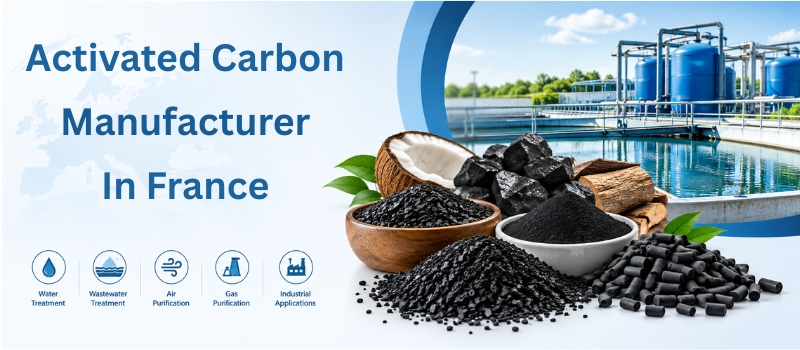
Finding a reliable activated carbon manufacturer in France is important for businesses that depend on adsorption, filtration and purification processes. The right activated carbon can support water treatment, wastewater treatment, air purification, gas treatment and a range of industrial processes, but the correct grade depends on the application rather than on one specification alone.
MICBAC India is an activated carbon manufacturer producing coconut shell, coal and wood-based activated carbon for industrial and commercial applications. Its product range includes Granular Activated Carbon (GAC), Powdered Activated Carbon (PAC) and Pelletised Activated Carbon in different grades for specific treatment requirements.
For buyers in France, choosing the right activated carbon starts with understanding the contaminant, process conditions and required treatment performance. Factors such as pore structure, particle size, iodine number, moisture, ash, hardness, contact time and flow rate can all influence how a particular grade performs.
Whether the requirement is for a water treatment facility in Paris, an industrial wastewater application in Lyon, a manufacturing process in Marseille or an air purification system elsewhere in France, the carbon should be selected according to the actual process requirement.
Activated Carbon Supply for Industries Across France
Activated carbon is used across many industries, and requirements can vary considerably from one application to another.
Businesses operating in major centres such as Paris, Lyon, Marseille, Toulouse, Lille, Bordeaux, Nantes, Strasbourg, Nice, Montpellier, Rennes and Grenoble may use activated carbon for water purification, wastewater treatment, process filtration, air treatment or other adsorption requirements.
Demand can also come from smaller cities and industrial areas such as Rouen, Reims, Metz, Nancy, Amiens, Dijon, Brest, Toulon, Clermont-Ferrand and Saint-Étienne.
The location itself does not determine which activated carbon should be used. A food-processing company in Lille may need a different grade from a wastewater treatment operation in Marseille, while a gas purification application near Lyon may require different physical characteristics from a water treatment system near Paris.
This is why product selection should begin with the application and operating conditions, followed by an evaluation of the appropriate carbon grade.
Activated Carbon Products for French Applications
Granular Activated Carbon
Granular Activated Carbon is commonly used in fixed-bed filtration systems. Water, wastewater, air or gas passes through a bed of carbon, allowing suitable contaminants to be adsorbed within the carbon’s pore structure.
GAC can be considered for applications including:
- Water treatment
- Industrial wastewater treatment
- Wastewater polishing
- Dechlorination
- Taste and odour control
- Removal of selected organic compounds
- Industrial filtration
- Air and gas purification
Particle size is an important consideration when selecting GAC. It can affect pressure drop, contact characteristics, filtration behaviour and handling. The appropriate size should therefore be selected according to the design and operating conditions of the treatment system.
Powdered Activated Carbon
Powdered Activated Carbon is generally added directly to a liquid process. It can be useful when adsorption is required during a batch or continuous treatment process without using a conventional fixed-bed carbon filter.
PAC can be considered for:
- Industrial effluent treatment
- Wastewater treatment
- Decolourisation
- Process purification
- Removal of selected organic impurities
- Batch treatment processes
The correct PAC grade depends on the contaminant, dosage, mixing conditions, contact time and required treatment objective.
Pelletised Activated Carbon
Pelletised activated carbon is produced in a cylindrical form and is commonly considered for air and gas purification.
Its physical form can be useful in systems where mechanical strength, airflow and pressure-drop characteristics are important. Applications may include VOC adsorption, odour control, air purification and selected gas-treatment processes.
The appropriate pellet size and specification depend on the gas composition, contaminant concentration, airflow, temperature and bed design.
Coconut Shell vs Coal-Based Activated Carbon
Coconut shell and coal-based activated carbons have different pore structures and can therefore be suitable for different adsorption requirements.
Coconut shell activated carbon generally has a highly microporous structure. Certain grades can be useful for applications involving smaller molecules and selected water and purification processes.
Coal-based activated carbon can provide a broader combination of micropores, mesopores and macropores. Some grades may therefore be more suitable for larger molecules or more complex industrial contaminants.
However, raw material should not be the only basis for product selection. Activation method, pore distribution, particle size, hardness, ash content and other characteristics can also influence performance.
For this reason, buyers should compare the technical specifications of the actual grades being offered rather than assuming that one raw material is universally better than another.
Activated Carbon for Water and Wastewater Treatment in France
Water and wastewater treatment are important applications for activated carbon. Depending on the process, activated carbon can help adsorb certain dissolved organic compounds and support the reduction of unwanted taste, odour and other contaminants.
Industrial wastewater can be particularly variable because its composition depends on the manufacturing process. Food and beverage production, pharmaceutical processing, chemical manufacturing and other industries can produce very different wastewater streams.
There is therefore no single activated carbon grade that should automatically be considered suitable for every water or wastewater application.
Before selecting a product, buyers should understand factors such as:
- Target contaminant
- Inlet concentration
- Required outlet concentration
- Flow rate
- Contact time
- pH
- Temperature
- Existing treatment stages
- Expected carbon consumption
- Required particle size
Providing this information to an activated carbon manufacturer allows the available grades to be evaluated against the actual treatment requirement.
Activated Carbon for French Industrial Applications
Activated carbon has applications across a wide range of industries in France. The required product characteristics can vary considerably depending on the process.
Food and Beverage Processing
Activated carbon can be used in selected food and beverage processes for decolourisation, purification and removal of unwanted organic compounds.
Where carbon is used directly in a process stream, the buyer should confirm that the selected grade and accompanying documentation are appropriate for the intended application.
Pharmaceutical Processing
Activated carbon may be used for selected purification and decolourisation applications in pharmaceutical processing. Consistent specifications, suitable quality controls and appropriate documentation can be particularly important in these environments.
Chemical and Manufacturing Processes
Chemical and manufacturing facilities may require activated carbon for process purification, wastewater treatment or adsorption of selected organic contaminants.
The molecular characteristics and concentration of the target contaminant should be considered when determining the appropriate pore structure and product grade.
Air and Gas Purification
Granular and pelletised activated carbon can be considered for selected air and gas treatment applications, including VOC adsorption, odour control and purification.
Gas composition, contaminant concentration, airflow, temperature and contact time should all be considered when evaluating a carbon for these systems.
How to Choose the Right Activated Carbon Grade
Choosing activated carbon solely according to iodine number is a common purchasing mistake.
Iodine number is an important technical parameter, but it does not describe every property that affects adsorption. A carbon with a higher iodine number is not automatically the correct choice for every application.
Depending on the process, buyers may need to evaluate:
- Iodine number
- Methylene blue value
- Surface area
- Pore size distribution
- Moisture
- Ash content
- Hardness
- Bulk or apparent density
- Particle size
- pH
Operating conditions also matter. Flow rate, contact time, temperature, pH, contaminant concentration and molecular size can all affect adsorption behaviour.
The objective should therefore be to select a carbon whose overall characteristics match the treatment process rather than focusing on one headline specification.
What Should You Ask an Activated Carbon Manufacturer?
For French buyers, evaluating a manufacturer involves more than comparing the price per tonne.
A supplier should be able to provide enough technical and commercial information for the buyer to assess product suitability, quality and supply requirements.
Technical Specifications
Request the complete product specification and identify which parameters are relevant to the application.
Certificate of Analysis
A Certificate of Analysis can provide batch-specific information and help confirm that supplied material meets the agreed product specification.
Safety Data Sheet
A Safety Data Sheet provides important information relating to handling, storage and safety considerations.
Product Samples
A representative sample can be useful for laboratory or pilot testing before committing to a larger quantity.
Quality Control
Ask about raw-material control, production controls and finished-product testing. Consistency between batches can be important when activated carbon is used continuously.
Packaging
Packaging should protect the carbon during handling, storage and transportation. The appropriate format depends on the product, quantity, storage conditions and handling system.
Production and Supply Capacity
For recurring industrial requirements, manufacturing capacity and supply continuity should be considered alongside the initial product specification.
Activated Carbon Supply to Paris, Lyon, Marseille and Other French Locations
Activated carbon requirements are not limited to France’s largest cities.
Companies in Paris and its surrounding industrial areas may require carbon for water treatment, process filtration or purification. Lyon and nearby industrial centres can have requirements associated with manufacturing, wastewater and chemical processes. Marseille and southern regions may have demand across industrial, environmental and water-treatment applications.
Other locations, including Toulouse, Lille, Bordeaux, Nantes, Strasbourg, Nice, Montpellier, Rennes, Rouen, Reims, Metz, Nancy, Dijon, Grenoble, Brest and Clermont-Ferrand, can also have different industrial and commercial applications for activated carbon.
For smaller cities and regional industrial areas, the same principle applies. The carbon grade should be selected based on the process, while packaging, quantity, shipment planning and destination requirements determine the practical supply arrangement.
International Activated Carbon Supply for French Buyers
When buying activated carbon from an international manufacturer, the product itself is only one part of the procurement process.
French buyers should also consider shipment planning, packaging integrity, import documentation, lead times and supply continuity.
For recurring requirements, it can be useful to discuss expected consumption and order frequency with the manufacturer. Maintaining an appropriate level of stock can also help reduce the risk of interruptions when activated carbon is an important part of an ongoing treatment process.
The overall cost should be considered rather than comparing only the initial price per tonne. Carbon consumption, replacement frequency, transport, disposal, labour and potential process downtime can all contribute to the actual cost of using a particular grade.
Why Consider MICBAC India for Activated Carbon Supply to France?
MICBAC India manufactures activated carbon from coconut shell, coal and wood-based raw materials. Its product range includes Granular Activated Carbon, Powdered Activated Carbon and Pelletised Activated Carbon for a range of industrial and purification applications.
MICBAC states an annual production capacity of 20,000 metric tonnes and supplies activated carbon to international markets.
For French buyers, these capabilities should be considered alongside the specific requirements of the application. Product specifications, sample evaluation, quality documentation, packaging, production capacity and international supply arrangements are all relevant when evaluating a manufacturer.
MICBAC’s manufacturing operations are based in India rather than France. For customers in France, the relevant consideration is therefore the manufacturer’s ability to provide the required activated carbon grade and support the associated international supply requirements.
Providing details such as the application, target contaminant, flow rate, required carbon form, particle size, expected quantity and delivery destination can help establish which available grade should be evaluated.
Common Mistakes When Buying Activated Carbon
Choosing only by iodine number
Iodine number is useful, but it does not determine whether a carbon is suitable for every contaminant.
Choosing only by raw material
Coconut shell, coal and wood have different characteristics, but the finished product’s pore structure and physical properties also matter.
Ignoring particle size
Particle size can affect pressure drop, filtration behaviour, contact characteristics and handling.
Ignoring operating conditions
Flow rate, contact time, pH, temperature and contaminant concentration can influence adsorption performance.
Buying without testing
Laboratory or pilot testing can provide useful information before a larger purchase, particularly for applications involving specific contaminants.
Comparing only price per tonne
A lower purchase price does not necessarily mean a lower overall treatment cost. Carbon consumption, replacement frequency, transport and disposal should also be considered.
Ignoring documentation
Technical specifications, batch information and safety documentation help buyers evaluate product quality and suitability.
Frequently Asked Questions
What is the best activated carbon for water treatment in France?
There is no single grade that is best for every water treatment application. The appropriate carbon depends on the target contaminant, water chemistry, flow rate, contact time, treatment system and required performance.
How do I choose an activated carbon manufacturer for France?
Consider manufacturing capability, product range, technical specifications, quality controls, sample availability, documentation, production capacity, packaging, export experience and supply continuity.
Is coconut shell activated carbon better than coal-based activated carbon?
Neither is universally better. Coconut shell carbon generally has a highly microporous structure, while coal-based carbon can provide a broader pore distribution. The appropriate choice depends on the contaminant and process conditions.
What specifications should I request from an activated carbon manufacturer?
Depending on the application, relevant specifications can include iodine number, methylene blue value, surface area, pore structure, moisture, ash, hardness, density, particle size and pH. A Certificate of Analysis and Safety Data Sheet may also be required.
Can activated carbon be supplied to different cities in France?
International supply arrangements can serve customers in different French locations. The final arrangement depends on the product, quantity, packaging, destination and logistics requirements.
Can I test activated carbon before purchasing in bulk?
A representative sample can be requested for laboratory or pilot testing. Testing can help determine whether a particular grade is appropriate for the intended process before a larger purchase.
What information should I provide when requesting activated carbon?
Useful information includes the application, target contaminant, liquid or gas phase, flow rate, contact time, operating conditions, required carbon form, particle size, expected quantity, packaging requirements and delivery destination.
Does MICBAC manufacture activated carbon in France?
MICBAC’s manufacturing operations are based in India. The company supplies activated carbon to international markets, including France. French buyers can evaluate the available grades according to their technical and supply requirements.
Request Activated Carbon for Your Application in France
Selecting an activated carbon manufacturer should involve more than comparing prices or choosing the product with the highest headline specification.
The right carbon depends on the contaminant, pore structure, particle size, operating conditions, required adsorption characteristics and the practical requirements of the treatment system.
MICBAC India manufactures coconut shell, coal and wood-based activated carbon in granular, powdered and pelletised forms for a range of applications. French buyers can provide their process requirements, technical specifications and expected quantities to evaluate a suitable grade.
Whether the requirement is for water treatment in Paris, industrial wastewater treatment in Lyon, process purification in Lille, air treatment in Marseille or another application elsewhere in France, the starting point remains the same: understand the application first, then select the carbon.